


Chevy Trax Common Problems to Watch Before Buying

If you’re shopping for a Chevy Trax, you may be wondering whether it’s a reliable small SUV or whether certain problems should make you look elsewhere. The short answer is that the Trax can be a practical, affordable choice, but the model year and condition matter.
The biggest thing to understand is that the Trax was significantly redesigned for 2024. Older Trax models and the newer generation should not be treated as the same vehicle when you’re researching reliability. The 2024-and-newer Trax uses a 1.2-liter turbocharged three-cylinder engine and six-speed automatic transmission, while earlier models used a different powertrain.
Quick Answer:The Chevy Trax can be a practical and reliable small SUV, but common problems vary by model year. Older models may have engine, oil leak, or transmission concerns, while newer models can experience infotainment, electrical, and A/C issues. Always check maintenance history, recalls, and vehicle condition before buying. |
Quick Comparison: Which Chevy Trax Is Right for You?
| Trax option | Best for | Why it makes sense |
| 2015–2018 used Trax | Lowest purchase price | Older models can be inexpensive, but condition and maintenance history are especially important |
| 2019–2022 used Trax | Budget-conscious buyers | Later first-generation models can offer good value when properly maintained |
| 2024–2025 Trax | Newer technology and updated design | Second-generation Trax offers a roomier design, modern technology, and a different powertrain |
| 2026 Trax | Buyers wanting a current model | Current Trax uses a 1.2L turbo engine, FWD, and offers up to 54 cu. ft. of cargo space |
| Chevrolet Certified Pre-Owned Trax | Buyers wanting extra coverage | CPO vehicles receive a 172-point inspection and additional limited-warranty coverage |
Compare Chevy Trax Models and PricingReview available trims and pricing to find the Trax that fits your needs. |
What Are the Most Common Chevy Trax Problems?
The phrase Chevy Trax common problems covers several different generations, so it helps to separate reported issues from confirmed safety defects or recalls.
Here are the areas worth checking.
1. Engine Performance and Oil-Related Concerns

Engine-related complaints appear among reported Trax problems, particularly on some older first-generation vehicles.
For older Trax models, reported problems can include:
- Hesitation during acceleration
- Oil leaks
- Coolant leaks
- Turbocharger-related concerns
- Check engine light issues
Repair information covering the first-generation Trax also identifies oil and coolant leaks, lack of power, and rattles or shakes among problems technicians may encounter.
Check:
- Maintenance records
- Oil-change intervals
- Warning lights
- Engine noises during a cold start
- Turbocharger operation
- Whether previous engine repairs were completed properly
A vehicle with complete service records and no current symptoms deserves much more consideration than one with an unexplained check engine light or a history of repeated engine repairs.
2. Infotainment and Electrical Problems

Technology-related problems are one area to pay close attention to, particularly on newer Trax models.
The bulletin specifically instructed technicians not to replace parts for that condition and instead follow updated diagnostic guidance.
Owner reviews also mention intermittent infotainment problems, screens locking up, connectivity issues, and other electronic glitches. Edmunds’ owner-review summary for the 2024 Trax shows technology and infotainment among the areas receiving complaints, although the overall owner sentiment remains mixed.
During your test drive, don’t just check whether the screen turns on.
Test:
- Center touchscreen
- Apple CarPlay or Android Auto
- Backup camera
- Steering-wheel controls
- Radio controls
- USB ports
- Power windows and locks
- Exterior lights
If a screen freezes once during a short test drive, don’t automatically walk away. Ask whether software updates or previous repairs have been completed, and have the vehicle inspected if necessary.
3. Transmission Behavior
Transmission problems are not something you should automatically expect from every Chevy Trax. However, transmission behavior should always be part of a used-car inspection.
A test drive can reveal warning signs that deserve further investigation.
Signs of a bad transmission
Watch for:
- Delayed engagement when shifting into Drive or Reverse
- Hard or unusually harsh shifts
- Shuddering or vibration
- Slipping during acceleration
- RPMs rising without a corresponding increase in speed
- Hesitation when accelerating
- Grinding, whining, or unusual noises
- Transmission-fluid leaks
- Warning lights
A single unusual shift does not necessarily mean the transmission is failing. Temperature, driving conditions, software, and other mechanical issues can affect how a vehicle behaves.
4. Air Conditioning and Climate-Control Concerns
Some 2024 Trax owner reviews mention air-conditioning or climate-control concerns. Edmunds’ owner-review data also lists climate control among areas where owners have reported issues.
This is easy to test before buying.
Turn the climate system through several settings and check:
- How quickly the A/C becomes cold
- Whether airflow is strong
- Whether different vents respond correctly
- Whether the fan operates at all speeds
- Whether unusual noises come from the HVAC system
For a used vehicle, don’t assume an A/C issue is a minor inconvenience. A diagnosis can help determine whether you’re dealing with a simple component or a more expensive repair.
Chevy Trax Years to Avoid: Is There a Bad Year?
Searching for Chevy Trax years to avoid can produce very long lists online. The reality is more nuanced.
There is no official Chevrolet list declaring certain Trax model years “bad” or unsafe to buy. Complaint data can show which years have generated more reports, but complaint totals should be considered alongside vehicle age, sales volume, mileage, maintenance history, and the type of complaint.
At the same time, some older model years have substantially fewer complaints in available datasets. That does not automatically make them more reliable, because fewer complaints can also reflect lower mileage, fewer vehicles in use, or differences in reporting.
What about the 2024 Trax?
The 2024 model is particularly important because it represents a complete redesign rather than simply another year of the older Trax.
That means you should not use reliability information from a 2017 or 2019 Trax as though it directly describes a 2024 or newer model.
The 2024 Trax did have documented software and recall-related concerns. For example, GM issued a voluntary emissions recall involving certain 2024 Trax vehicles with the 1.2L engine. The issue involved engine-control-module ignition timing following certain Auto Engine Stop/Start events, which could cause a check engine light, rough running, or knocking.
Is Chevy Trax a Reliable Car?
The Chevy Trax can be a reliable car for many owners, but reliability depends heavily on model year, maintenance, mileage, and individual vehicle condition.
For the 2024 Trax, Consumer Reports describes overall reliability as about average compared with other vehicles from the same model year. Edmunds also reports mixed owner experiences, with many owners praising the Trax’s ride, space, value, and fuel economy while others mention technology, A/C, and reliability concerns.
Is this particular Trax a good vehicle for the price?
The important question when shopping for used vehicles is not simply whether the model has ever had engine complaints. Instead, look at the individual vehicle.
A used Trax with:
- One or two owners
- Consistent maintenance
- No unresolved recalls
- No warning lights
- A clean inspection
- Good tires and brakes
- No major accident history
- A reasonable price
A well-maintained used Trax can be a better purchase than a neglected newer one, so compare condition, mileage, and pricing across available vehicle inventory before deciding.
What to Check Before Buying a Used Chevy Trax
Before signing paperwork, work through this inspection list.
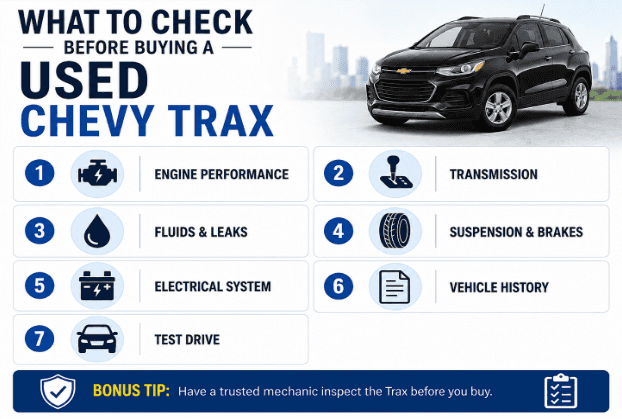
Inspect the Engine
Start the vehicle when the engine is cold if possible.
Listen for:
- Knocking
- Ticking
- Excessive rattling
- Rough idle
- Unusual turbo noises
Also, look for fluid leaks and check whether warning lights remain illuminated after startup.
Test the Transmission
Drive the vehicle through:
- Stop-and-go traffic
- Light acceleration
- Moderate acceleration
- Reverse
- Uphill driving
- Highway speeds, where safe
Pay attention to how smoothly the transmission engages and shifts.
Fluids & Leaks
- Check fluid levels: Inspect the engine oil, coolant, brake fluid, and transmission fluid for proper levels and condition.
- Look for leaks: Check underneath the Chevy Trax for oil, coolant, or other fluid leaks that could indicate maintenance issues.
Check Tires, Brakes, and Suspension
Look for:
- Uneven tire wear
- Low tread depth
- Brake vibration
- Pulling under braking
- Clunking over bumps
These items can also become negotiation points if they need attention soon.
Test Every Electronic Feature
Spend a few extra minutes with the touchscreen, camera, windows, lights, climate controls, and other electronic systems.
Review the Vehicle History
Ask for the vehicle history report and look for:
- Accident records
- Title issues
- Number of previous owners
- Service records
- Mileage consistency
- Rental or fleet history
- Major repairs
A clean history report is useful, but it isn’t a substitute for an inspection.
Test Drive
Test driving conditions: Drive on city streets and highways to assess acceleration,
- braking
- Steering
- handling
Listen for unusual behavior:
- Watch for vibrations
- strange noises
- rough shifting
- warning lights during the drive.
Should You Buy an Extended Warranty for a Used Chevy Trax?
An extended warranty for used cars can make sense when you’re buying a vehicle outside its original coverage and want protection against unexpected repair bills.
Before purchasing one, compare:
- Coverage length
- Mileage limit
- Deductible
- Powertrain coverage
- Electrical coverage
- Turbocharger coverage
- HVAC coverage
- Transmission coverage
- Exclusions
- Maintenance requirements
- Transferability
- Cancellation terms
Don’t assume every extended warranty covers every problem.
How to Negotiate Price on a Used Car With Known Problems
Knowing how to negotiate price on a used car is easier when you bring evidence instead of simply asking for a discount.
If a Trax needs tires, brakes, A/C work, or another repair, get an estimate for the work.
Then use this approach:
Vehicle asking price − documented repair costs = starting point for your negotiation
For example, if a vehicle is priced at $20,000 and you have a documented $1,200 repair requirement, you have a stronger negotiating position than simply saying, “I think the car is worth less.”
Also, compare the vehicle with current vehicle inventory to see how similar models are priced before negotiating.
Don’t negotiate only on the sticker price
Look at the complete purchase equation:
- Vehicle price
- Taxes
- Dealer fees
- Financing rate
- Warranty cost
- Immediate repairs
- Tires and brakes
- Expected maintenance
Cost to Replace a Chevy Trax Transmission
- Transmission replacement cost: Replacing a Chevy Trax transmission can typically cost around $3,000–$5,000 or more, depending on the model year, transmission type, parts, and labor rates.
- Repair or rebuild option: A transmission repair or rebuild may cost less, often making it worth getting a professional diagnosis before approving a full replacement.
- Used Trax tip: If a used Trax shows slipping, harsh shifting, delayed engagement, or unusual transmission noises, have a mechanic inspect it before buying.
Chevy Trax Common Problems: Final Takeaway
The Chevy Trax common problems buyers hear about include engine concerns on some older models, infotainment and electrical glitches, A/C issues, and transmission symptoms that should be checked during a used-vehicle test drive.
The more important factors are model year, maintenance history, mileage, condition, recall status, repair history, and price.
A CPO Trax can be a useful middle ground if you want a used vehicle with additional inspection and warranty coverage.
Before buying, check the VIN, review the history, test every system, take a proper test drive, and get an inspection when appropriate. Then compare the total cost of ownership rather than focusing only on the advertised price.
Ready to Find the Right Chevy Trax?Compare available models and choose the Trax that fits your budget and daily needs. |
Frequently Asked Questions
What are the most common Chevy Trax problems?
Commonly reported areas include engine performance, oil or coolant leaks on some older models, electrical and infotainment issues, A/C concerns, and transmission symptoms. The exact issues vary significantly by model year, so buyers should research the specific year and inspect the individual vehicle rather than assuming every Trax has the same problems.
What Chevy Trax years should I avoid?
There is no official list of Chevy Trax years that every buyer should avoid. Some complaint databases show higher complaint volumes for certain older years, including 2019, while the 2024 redesign introduced a different powertrain and had some documented software and recall-related concerns.
Is the Chevy Trax a reliable car?
The Chevy Trax can be reliable when it is properly maintained, but reliability varies by generation and individual vehicle condition. In 2025, the Trax’s Quality & Reliability is 84/100, while Consumer Reports describes the 2024 model’s reliability as about average for its model year.
What are the signs of a bad transmission in a Chevy Trax?
Watch for delayed engagement, hard shifting, slipping, shuddering, unusual noises, hesitation, or engine RPM increasing without a matching increase in vehicle speed. If you notice several of these symptoms during a test drive, have the vehicle inspected before purchasing it.
Is an extended warranty for used cars worth it?
It can be worthwhile if the vehicle is outside its original warranty and you want protection from potentially expensive repairs. Compare the warranty’s deductible, exclusions, powertrain and electrical coverage, mileage limits, and total price before deciding, and compare those benefits with any CPO warranty that comes with the vehicle.
0 comment(s) so far on Chevy Trax Common Problems to Watch Before Buying