


Chevy Traverse Years to Avoid: A Used-Buyer Guide
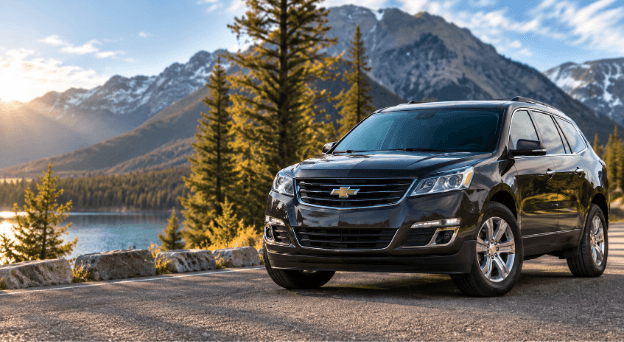
A used Chevrolet Traverse can be a great fit for families who need extra space, but not every model year is equally reliable. If you are researching Chevy Traverse years to avoid, pay close attention to 2009–2012, especially 2009. The 2018 Traverse also deserves a closer look because of reported transmission shudder.
That said, the model year is only part of the story. Maintenance history, mileage, previous repairs, and overall condition can make a big difference when buying used.
Chevy Traverse Years to Avoid at a Glance
For most used buyers, these are the model years I would either skip or buy only after a thorough inspection and complete service-history review.
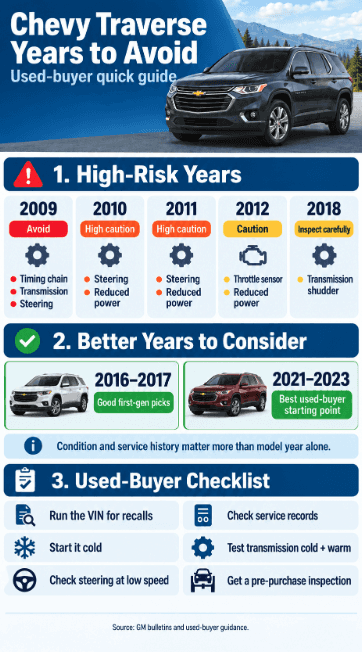
The biggest distinction is between a model-year reputation and a specific vehicle. A 2011 Traverse with extensive documented repairs and consistent maintenance may be a better purchase than a newer SUV with a poor history.
| Want to compare available options instead of sorting through unknown private-party histories? |
Why the 2009 Traverse Deserves the Most Caution
The 2009 Traverse was the first model year and has several well-documented concerns. GM documented premature timing-chain wear in certain 2009 models through a special coverage bulletin that applied for up to 10 years or 120,000 miles.
GM also issued special coverage for some 2009 Traverse vehicles with a 6-speed automatic transmission because a wave plate could crack and affect third, fifth, and reverse gears. Review the GM transmission special coverage notice.
In addition, 2009–2011 models were included in a power-steering coverage program for possible pump wear and reduced steering assist. Together, these issues make the 2009 Traverse a model that deserves extra caution, especially if maintenance and repair records are incomplete.
Why 2010 and 2011 Still Need a Careful Inspection
The 2010 and 2011 Traverse do not share every 2009-specific issue, but they were still included in important GM service programs.
GM’s power-steering coverage applied to 2009–2011 models, while certain 2009–2012 vehicles were covered for a throttle-position sensor issue that could cause rough running, warning messages, or reduced engine power. Read the GM throttle-body special coverage bulletin.
If you are considering either year, check the steering system, throttle body, timing components, and transmission, and ask for invoices confirming any repairs.
Why 2012 Is More of a High-Caution Year Than an Automatic No
The 2012 Traverse deserves caution, but it is not necessarily an automatic skip. Certain 2009–2012 models were covered for a throttle-position sensor condition that could cause rough running and reduced engine power.
At this age, however, vehicle condition matters heavily. A 2012 Traverse with documented maintenance, no warning lights, and a clean inspection may still be worth considering. One with incomplete records or signs of neglect is a much bigger risk.
In short, use the model year as a warning sign, then let the vehicle’s history and inspection determine whether it is worth buying.
What to Know About the 2018 Traverse
The 2018 Traverse introduced the redesigned second generation and a new nine-speed automatic transmission, so it deserves extra attention as a first-year redesign.
GM issued a technical service bulletin covering possible low-speed transmission shudder under light throttle. The recommended correction could include transmission-control-module programming and fluid service. See the GM 2018 transmission bulletin hosted by NHTSA.
This does not mean every 2018 Traverse has transmission problems. During a test drive, watch for shuddering, hesitation, delayed engagement, hard shifts, or unusual behavior between Reverse and Drive. If anything feels off, get it inspected before buying.
Most Common Chevy Traverse Problems to Check Before Buying
The most important Chevy Traverse problems vary by generation and model year, but used buyers should focus on a few systems because failures there can be expensive or affect drivability.
Engine and Timing Components
The strongest documented timing-chain concern applies to certain 2009 models. On any older Traverse, however, listen during a cold start for abnormal rattling, check for warning lights, and review oil-change records. Oil history matters because engine wear can accelerate when maintenance has been inconsistent.
Reduced Engine Power
Certain 2009–2012 models were covered for a throttle-position-sensor condition that could cause rough running or reduced engine power. If the seller mentions intermittent reduced-power messages, do not accept a cleared warning light as proof the problem is solved. Ask for the repair record and scan the vehicle for stored diagnostic codes.
Steering Feel
On 2009–2011 models, steering deserves special attention because of GM’s power-steering coverage. During a test drive, turn the wheel at parking-lot speeds and listen for whining while checking whether steering effort changes unexpectedly.
Transmission Behavior
The early 2009 six-speed wave-plate condition and the 2018 nine-speed shudder bulletin are different problems, but both reinforce the same buying rule: never judge an automatic transmission only during a short, gentle drive. Test it cold and warm, in stop-and-go traffic and at normal road speed, and use both forward and reverse gears before making a decision.
Chevy Traverse Transmission Problems: What Should You Test?
When checking for Chevy Traverse transmission problems, focus less on whether the vehicle “shifts” and more on how consistently it shifts.
During the test drive:
- Start with the vehicle cold if possible.
- Shift from Park to Reverse and then Drive. Engagement should be predictable rather than delayed or harsh.
- Accelerate lightly through several gears and watch for shuddering, slipping, flaring RPM, or abrupt gear changes.
- Drive long enough for the transmission to reach operating temperature.
- Repeat low-speed acceleration after the vehicle is warm.
- Reverse into a parking space and make sure Reverse engages normally.
- Check underneath for signs of fluid leakage.
- Ask whether transmission fluid service, software updates, or transmission repairs have already been completed.
A pre-purchase inspection is especially worthwhile if the vehicle has high mileage or the service history is incomplete. Riverton Chevrolet’s Certified Service Center can inspect Chevrolet vehicles and help identify maintenance or repair needs.
Chevy Traverse Reliability: Are the Later Years Better?
Chevy Traverse reliability is best judged by generation, vehicle history, and condition rather than by assuming one score applies to every year.
The first generation ran through 2017, while 2018 introduced a major redesign. Chevrolet then redesigned the Traverse again for 2024 with a new 2.5L turbocharged engine and an eight-speed automatic transmission.
For shoppers who want to reduce uncertainty, later first-generation models such as 2016–2017 and later second-generation models such as 2021–2023 are sensible places to start. They avoid the first model years discussed above while giving buyers a longer ownership and service history to review than the newest redesigned models.
That is not a promise that every later vehicle will be trouble-free. A 2022 model that skipped maintenance can still be a worse purchase than a carefully maintained older Traverse.
| Do you prefer additional inspection and warranty protections? |
What is the Best Year for Chevy Traverse Shoppers?
There is no universal best year for Chevy Traverse buyers because budget, mileage, features, and ownership history all matter. For a used buyer trying to balance modern features with a platform that has already been on the road for several years, I would start by comparing 2021, 2022, and 2023 models.
The 2022 Traverse, for example, came with the 3.6L V6 and nine-speed automatic, and Chevrolet made Chevy Safety Assist standard across trims.
The 2024 redesign brings newer technology and a different 2.5L turbocharged powertrain, but newer vehicles naturally have less long-term used-market history. Chevrolet describes the 2024 model as redesigned from the ground up.
If value is the priority, a well-documented 2016–2017 model can also be worth comparing. If newer safety and convenience technology matters more, start with 2021–2023 and compare mileage, trim, service history, and price.
A Used Traverse Inspection Checklist
Before buying any Traverse, especially one of the higher-caution years, use this checklist.
- Run the VIN through NHTSA. Use the official NHTSA recall lookup to see whether the specific VIN has an unrepaired safety recall. NHTSA notes that the VIN lookup identifies whether a particular vehicle requires recall repair.
- Review the vehicle-history report. Look for accident history, title issues, ownership changes, and recorded maintenance.
- Ask for service invoices. A stamped maintenance book is useful, but invoices can show exactly what was repaired.
- Start the engine cold. Listen for rattles and watch for delayed warning lights.
- Scan for diagnostic codes. Recently cleared codes can be as important as active ones.
- Test the steering at low speed. Parking-lot turns can reveal noise or inconsistent assist.
- Drive the transmission cold and warm. Look for shudder, slip, harsh engagement, or delayed shifts.
- Check every electrical feature. Test the climate system, infotainment, windows, locks, cameras, liftgate, and driver-assistance features fitted to the vehicle.
- Inspect underneath. Look for fluid leaks, corrosion, damaged splash shields, or evidence of recent cleanup around a leak.
- Get an independent pre-purchase inspection. This is one of the best ways to turn a model-year shortlist into a decision about a specific vehicle.
Riverton Chevrolet says its used inventory includes complimentary AutoCheck history reports, which can help buyers review accident and service information before deciding what to inspect more closely.
Need help narrowing the search? Explore Riverton Chevrolet’s used-vehicle inventory.
Final Thoughts: Choose the Vehicle, Not Only the Model Year
Knowing the Chevy Traverse years to avoid can help narrow your search, but model year should not be the only deciding factor. Be most cautious with 2009–2012 models, especially 2009, and inspect 2018 models carefully for transmission issues.
For a lower-risk starting point, consider 2016–2017 or 2021–2023 models. Always review service records, check the VIN, test the vehicle thoroughly, and get a pre-purchase inspection before buying.
| Looking for a used Chevy Traverse? |
Frequently Asked Questions
What year did the Chevy Traverse have transmission problems?
The 2009 Traverse had documented transmission issues involving a wave plate, while some 2018 models had reports of low-speed transmission shudder. Both years deserve a careful test drive and inspection before buying.
What is the best year of the Chevy Traverse to buy?
For used buyers, 2021–2023 models are practical options to consider because they came later in the second-generation run. Still, maintenance history, mileage, condition, and inspection results matter more than model year alone.
What are the most common problems with the Chevy Traverse?
Common issues reported on older Traverse models include timing-chain wear, transmission problems, power-steering issues, and reduced engine power. The exact risk depends on the model year, maintenance history, and current vehicle condition.
How do I check a used Traverse for open recalls?
Enter the vehicle’s 17-digit VIN into NHTSA’s official recall lookup tool. It will show whether the specific Traverse has any unrepaired safety recalls that still need attention.
Is it worth buying an older Chevy Traverse with high mileage?
It can be if the vehicle has strong maintenance records and passes a professional inspection. Check the engine, transmission, steering, leaks, warning lights, and repair history before deciding whether the price makes sense.
0 comment(s) so far on Chevy Traverse Years to Avoid: A Used-Buyer Guide